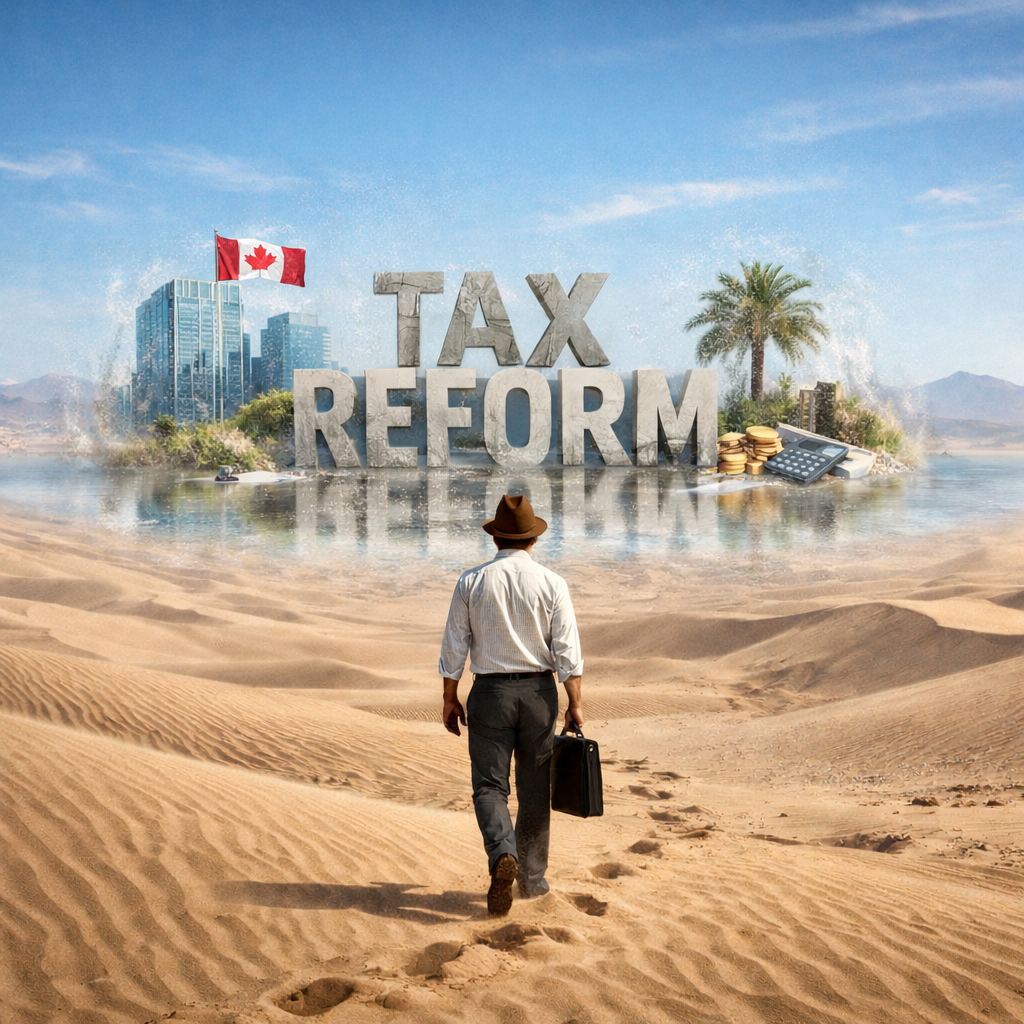
Is Comprehensive and Enduring Tax Reform a Mirage?
Every few years, Canada rediscovers tax reform.
Talk of a system that is simpler, fairer, and more growth-oriented is on everyone’s mind. Panels are convened, consultation papers released, and stakeholders mobilized around the belief that this time, the tax system can be fixed for good. Yet experience suggests a more sobering conclusion: comprehensive tax reform rarely endures. Even when reforms succeed initially, they are steadily reshaped, sometimes eroded, by shifting political priorities and economic pressures at both the federal and provincial levels.
This is not a failure of technical design. It is a reflection of the inherently political nature of taxation. Tax systems do not exist in a vacuum; they evolve alongside changing views on fairness, incentives, and the appropriate role of government. In a country as large and diverse as Canada, with competing regional interests and alternating political ideologies, the idea of a single, permanent overhaul may be more illusion than achievable outcome.
Recognizing this reality reframes the challenge. The question is not how to design a perfect tax system that will stand unchanged for decades, but how to manage inevitable change in a way that limits inefficiency, preserves fairness, and supports economic growth as priorities evolve.
The Political Foundations of Tax Policy
At its core, tax policy is inseparable from politics. Decisions about who pays, how much, and in what form reflect societal values as much as economic theory.
Proposals to raise taxes on high-income earners or wealth are often framed as tools to reduce inequality and fund public services. Conversely, calls to lower corporate taxes or capital gains taxes are typically justified as mechanisms to encourage investment, productivity, and long-term growth. Both perspectives can be defended on policy grounds, yet they rest on fundamentally different views of fairness and economic behavior.
Recent debate over the capital gains inclusion rate illustrates this tension clearly. Proposals to increase the rate were advanced as a matter of equity, while critics warned of reduced investment and capital flight. The subsequent withdrawal of those proposals underscored a recurring theme in tax reform: even well-intentioned changes can falter when economic incentives and political realities collide.
These debates are not anomalies. They are structural features of tax policy. As governments change, so too do the objectives imposed on the tax system, ensuring that any comprehensive reform remains vulnerable to reinterpretation or reversal.
The Inevitable Evolution of Tax Systems
Even if consensus could be reached on an “ideal” tax system, it would not remain static. Tax laws are amended continuously to respond to economic shocks, social priorities, fiscal constraints, and political commitments. Over time, these adjustments accumulate, often pushing the system further from its original design.
Canada’s experience with the Goods and Services Tax provides a useful example. Introduced in 1991 to replace the Manufacturers’ Sales Tax, the GST was widely viewed as a more efficient consumption tax. Yet over time, it has been modified through exemptions, rebates, and harmonization arrangements, each reflecting evolving political and economic objectives. What began as a relatively streamlined tax has grown increasingly complex.
Carbon pricing follows a similar pattern. Initially designed with national consistency in mind, it evolved regional exemptions, rebates, and ultimately resulted in the removal of the consumer levy while the industrial regime was left in place. The policy objective shifted, but the underlying lesson remained the same: tax measures are continuously reshaped by political acceptance.
Personal and corporate tax credits further illustrate this dynamic. Credits are often introduced to address specific policy goals—supporting families, encouraging investment, promoting environmental behavior or targeting relief to specific situations, like home renovation tax credits for seniors. Over time, incremental additions compound complexity, even when each individual change appears modest or justified.
Importantly, much of this growing complexity is not arbitrary. A significant portion arises from deliberate efforts to prevent tax avoidance and close perceived loopholes, ensuring the system achieves its intended policy objectives. As taxpayers and advisors respond rationally to incentives embedded in the law, governments react by introducing targeted rules, anti-avoidance provisions, and technical refinements. Each individual measure may be justified to protect the tax base or preserve fairness, but collectively they add layers of complexity that make the system harder to navigate.
This dynamic creates an inherent tension within tax design. Broad, principle-based rules may appear elegant and simple, but they are often vulnerable to planning strategies that undermine policy intent. Conversely, rules drafted with sufficient precision to limit avoidance tend to be detailed and complex. Over time, the effort to balance integrity with administrability becomes a key driver of complexity - particularly in areas involving capital income, corporate structures, and cross-border transactions.
The Mirage of Simplicity
“Simplicity” is among the most frequently cited goals of tax reform. In theory, a simpler system promises lower compliance costs, fewer errors, and greater transparency for taxpayers.
In practice, simplicity comes with trade-offs that are difficult to sustain politically. Eliminating deductions and credits may streamline administration, but it can also disproportionately affect families with children, caregivers, or lower-income households. These outcomes often prompt demands for targeted relief, reintroducing complexity in the name of fairness.
Similarly, reducing the number of tax brackets may simplify calculations but weaken perceptions of progressivity. Policymakers then respond by layering in surtaxes, credits, or income-tested benefits - again trading simplicity for equity.
The same tension arises in proposals to shift taxation away from income and toward consumption. While consumption taxes such as the GST are generally more efficient, they tend to be regressive, as lower-income households spend a greater share of their income on taxable goods and services. Although the GST Credit mitigates this effect, it may not fully offset the burden if consumption taxes were increased substantially to replace income tax revenue.
These examples highlight a recurring pattern: efforts to simplify the system often create distributional or integrity concerns that generate political pressure for corrective measures. Over time, simplicity gives way to complexity once again.
Incremental Change as Policy Reality
Against this backdrop, comprehensive and enduring tax reform begins to resemble a mirage. Reforms may address specific inefficiencies or inequities, but they rarely remain intact over the long term. Political compromise, unintended consequences, and shifting priorities ensure that tax systems evolve incrementally rather than through permanent resets.
The real policy choice, therefore, is not between comprehensive reform and incremental change. Incremental change is inevitable. The more meaningful distinction is whether those changes are reactive and ad hoc, or deliberate and well-considered.
Thoughtful incremental reform grounded in evidence, evaluated for unintended effects, and adjusted as outcomes become clear, offers a more realistic path forward. Rather than attempting to lock in a single vision of the tax system, policymakers can focus on improving how changes are made, ensuring they align with current objectives without unnecessarily increasing complexity.
The Essential Role of Tax Professionals
The continual evolution of Canada’s tax system reinforces the importance of skilled tax professionals. Navigating a system shaped by constant legislative change requires more than technical knowledge; it demands judgment, adaptability, and an understanding of how policy intent translates into real-world outcomes.
Professional accountants are uniquely positioned to meet these demands. Their training emphasizes both technical proficiency and practical application, equipping them to interpret complex rules and anticipate the downstream effects of policy changes. This foundation is strengthened through ongoing continuing professional development, ensuring practitioners remain current as legislation, jurisprudence, and administrative guidance evolve.
For individuals and businesses facing increasingly complex tax environments, professional accountants provide indispensable support, ensuring compliance while enabling informed decision-making in the face of uncertainty.
Conclusion
Comprehensive and enduring tax reform in Canada may be an appealing aspiration, but history suggests it is unlikely to be achieved in practice. Tax systems are political by nature, shaped continuously by shifting priorities, economic conditions, and societal values.
Much of the system’s complexity reflects conscious efforts to preserve fairness, protect the tax base, and prevent avoidance rather than poor design. That complexity, while often frustrating, is frequently the price paid to ensure the tax system functions as intended.
Rather than pursuing an elusive ideal of permanence or simplicity, policymakers would be better served by improving the quality of inevitable change. Incremental, evidence-based reforms implemented with awareness of trade-offs and unintended consequences offer a more realistic and sustainable approach. In this environment, professional accountants are not merely compliance advisors. They are essential guides within a system defined by constant evolution, helping taxpayers navigate complexity while contributing practical insight to the ongoing process of reform. Ultimately, the success of tax policy lies not in achieving perfection, but in managing change intelligently and ensuring the system remains workable, fair, and resilient over time.